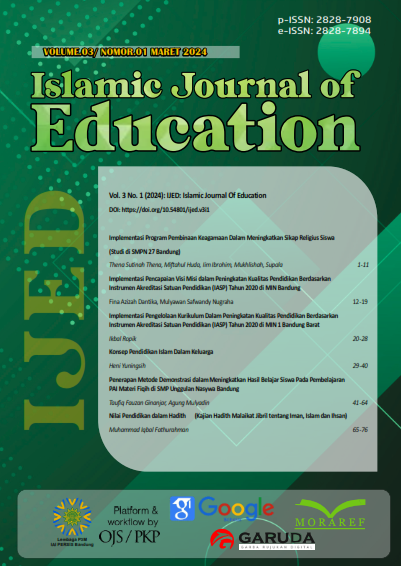
Implementation of Religious Guidance Programmes in Enhancing Students' Religious Attitudes: A Study at SMPN 27 Bandung
DOI:
https://doi.org/10.54801/4xthby14Keywords:
Knowledge Integration, Islamic Education, Unified Curriculum, Teacher Roles, MultidisciplinaryAbstract
Schools are places where students pursue knowledge. Every school has a vision and mission related to religion, as schools want to produce a generation with religious attitudes. According to the information obtained, the current phenomenon is that there are students who lack religious attitudes, including those who still like to use foul language, lack discipline, and lack manners. This is the background for the research on the implementation of religious guidance programmes at SMPN 27 Bandung so that students, as the Islamic generation, will have religious attitudes. This study aims to determine the religious guidance programme, its implementation, supporting factors (internal and external) and inhibiting factors (internal and external), as well as the impact of the implementation of the religious guidance programme. The method used in this study is descriptive analysis with a qualitative approach. The data collection methods used were observation, interviews and documentation review, with triangulation analysis techniques. The results of the study show that the implementation has had a fairly good impact on increasing religious attitudes, as demonstrated by the increase in: 1) humility, 2) respect for religious diversity/tolerance, and 3) cooperation in preparing places of worship
Downloads
Downloads
Published
Issue
Section
License
Copyright (c) 2025 Thena Sutinah Thena

This work is licensed under a Creative Commons Attribution-NonCommercial-ShareAlike 4.0 International License.
Data Lisence Terms
Choose how a default copyright date is selected or an article. This default can be overridden on a case-by-case basis. If you publish as you go, don't use the issue's publication date.